Entropy and Economics: Predictive Maintenance, Joule’s Law, and the ROI of Thermal Insight in the Industrial Age
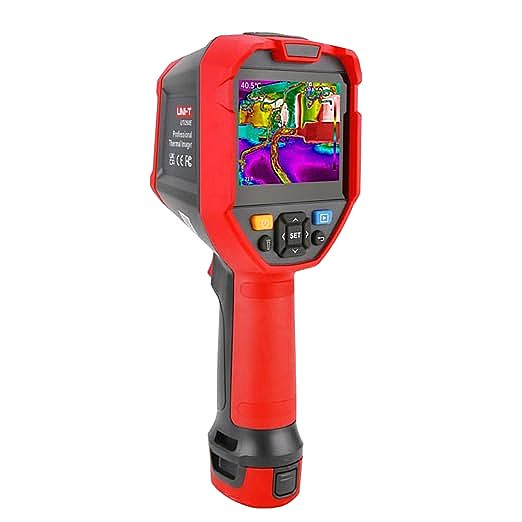
UNI-T UTi720E Industrial Professional Infrared Thermal Imager
The Second Law of Thermodynamics states that the entropy of an isolated system always increases. In the context of industrial and residential infrastructure, "entropy" manifests as decay, friction, resistance, and ultimately, failure. Every loose connection, every worn bearing, and every moisture intrusion is a local victory for entropy. Traditionally, we have managed this decay through Reactive Maintenance: wait for the machine to break, then fix it. This approach is economically inefficient and operationally hazardous.
The advent of accessible, high-resolution thermal imaging—exemplified by tools like the UNI-T UTi720E—has ushered in the era of Predictive Maintenance (PdM). This is not just a change in workflow; it is a change in the economic model of asset management. By detecting the thermal signatures of entropy before they result in catastrophic failure, we trade the high cost of downtime for the low cost of inspection. This article explores the engineering physics behind these thermal signatures and the actuarial economics of "seeing" the future of a machine.
I. The Electrical Signature: Joule’s Law and the High-Resistance Fault
Electrical failures are rarely sudden; they are progressive. They announce their presence long before they spark or trip a breaker, broadcasting a warning signal in the form of heat. This phenomenon is governed by Joule’s First Law: $P = I^2 R$.
The Physics of the Loose Connection
In an ideal circuit, connections have near-zero resistance. However, vibrations, thermal expansion/contraction cycles, and oxidation can loosen a screw terminal or corrode a contact. * The Resistance Spike: As the connection loosens, the contact area decreases, and Resistance ($R$) increases. * The Quadratic Punishment: According to the formula $P = I^2 R$, the power ($P$) dissipated as heat is linearly proportional to resistance but exponentially sensitive to current ($I$). In a high-current industrial panel, even a tiny increase in resistance (milliohms) can generate significant heat (Watts). * The Thermal Runaway: As the component heats up, metal oxides form faster (which are insulators), further increasing resistance, which generates more heat. This positive feedback loop eventually leads to melting, arcing, or fire.
Diagnosing with the UTi720E
A 256x192 resolution camera is critical here. An overloaded wire looks uniformly hot. A loose connection looks like a localized "hot spot" or gradient. * Load Imbalance: Thermal imaging can also instantly visualize phase imbalance in 3-phase systems. If Phase A is 50°C hotter than Phase B and C, it suggests an unequal load distribution, which stresses the neutral conductor and motor windings. * The -20°C to 550°C Range: The broad range of the UTi720E is vital. A slightly warm breaker might be 40°C, but a failing transformer connection could easily exceed 200°C. The ability to measure both ends of the spectrum without sensor saturation is a key requirement for electrical inspections.

(Note: Use a relevant electrical thermal image)
II. The Mechanical Signature: Tribology and Friction
In the mechanical world, heat is the byproduct of inefficiency. Tribology is the study of friction, wear, and lubrication. When lubrication fails, friction increases, and energy that should drive motion is converted into waste heat.
Bearing Failure Curves
A rolling element bearing follows a predictable failure curve (the P-F Curve).
1. Stage 1 (Ultrasound): Micro-defects appear. Detectable by ultrasound.
2. Stage 2 (Vibration): Defects grow. Detectable by vibration analysis.
3. Stage 3 (Heat): Friction increases significantly. Detectable by Thermal Imaging.
4. Stage 4 (Noise/Smoke): Catastrophic failure imminent.
While thermal is not the earliest indicator, it is often the most accessible. A bearing running 20°C hotter than its twin on the same shaft is a screaming red flag.
* Motor Alignment: Misaligned shafts create excessive radial loads, generating heat at the coupling and bearings. The UTi720E allows a technician to scan a line of motors and instantly identify the outlier.
* Fluid Power: In hydraulic systems, a internal leak across a valve seal forces fluid through a tiny orifice at high pressure. This pressure drop releases heat. A thermal camera can "see" the leak inside the valve body without disassembling a single bolt.
III. The Building Physics: Psychrometrics and the Envelope
Buildings are thermodynamic systems fighting to maintain a temperature difference ($\Delta T$) against the outside world. Thermal imaging is the primary tool for verifying the integrity of the "Building Envelope."
The Dew Point and Mold
Mold requires moisture. Moisture in walls often comes from condensation. Psychrometrics teaches us that air holds less water as it cools. When warm, humid indoor air hits a cold spot in the wall (Thermal Bridge), it drops below its Dew Point, and water condenses. * The Cold Spot Indicator: A thermal camera identifies areas of missing insulation or thermal bridging (where wood/metal studs conduct heat faster than insulation). These cold spots are the future breeding grounds for mold. By identifying them early, the UTi720E acts as a biological defense tool. * Evaporative Cooling: Water leaks are often visible thermally even if they are the same temperature as the room. Why? As water evaporates, it absorbs energy from the surface material (Enthalpy of Vaporization), making the damp spot appear cooler than the dry surroundings. This allows inspectors to map out the extent of water damage behind drywall non-destructively.
Floor Heating and HVAC
For systems like radiant floor heating, the UTi720E is indispensable. * Tracing the Loop: The hot water tubes embedded in concrete glow clearly in IR. You can map the entire system layout, find blockages (cold sections), or locate leaks (hot blooms) without jackhammering the floor blindly. * Ductwork Efficiency: In HVAC, uninsulated ducts in an attic lose massive amounts of energy. A thermal scan reveals these losses instantly, visualizing the money evaporating from the homeowner's wallet.
IV. The Economics of Insight: Calculating ROI
The purchase of a professional tool like the UTi720E ($700+) is a capital expenditure (CapEx). Its value is justified by the reduction in operational expenditure (OpEx) and risk avoidance.
The Cost of Downtime
In a manufacturing plant, a production line stopping for 1 hour might cost $10,000 in lost revenue. If a thermal inspection identifies a $50 overheating contactor that would have caused that shutdown, the ROI of the camera is achieved in a single detection. * The Insurance Model: Insurance companies love thermal imaging. Many require annual IR scans of electrical switchgear for commercial policies. Why? Because the actuarial data proves that thermal inspections drastically reduce the frequency and severity of fire claims. * The Technician's Efficiency: For a service technician (HVAC/Plumber), time is inventory. If the UTi720E helps locate a leak in 10 minutes instead of 2 hours of guessing and cutting drywall, the billable efficiency skyrockets. The Wi-Fi capability adds to this: taking a snapshot, annotating it on a phone, and emailing the report to the client on-site shortens the billing cycle and increases customer trust through "visual proof."
V. Conclusion: The Digital Upgrade of Maintenance
We are moving from an era of "Break-Fix" to an era of "Predict-Prevent." In this transition, data is the currency. The UNI-T UTi720E represents the digitization of thermal data. It converts the abstract concept of "heat" into a quantifiable, trackable, and actionable dataset.
Whether analyzing the Joule heating of a corroded wire, the frictional entropy of a dying bearing, or the psychrometric risk of a cold wall, the thermal imager provides a sixth sense. It allows us to intervene at the most economical point on the failure curve—before the damage is done. In the grand equation of infrastructure management, the cost of "seeing" is negligible compared to the cost of "blindness." Investing in thermal insight is, fundamentally, an investment in the resilience and efficiency of the systems that power our world.