Optimizing Culinary Ergonomics: A Study in Vertical Thermal Systems

KIDISLE CM9429D-UL 3 in 1 Single Serve Coffee Maker
The modern kitchen is facing a spatial crisis. As urbanization increases and residential square footage decreases, the "countertop" has become some of the most expensive real estate in the home. This shift has forced a re-evaluation of appliance architecture. The sprawling, horizontal footprints of 20th-century machines are no longer viable in the efficient, modular kitchens of the 21st century.
This constraint has given rise to the "Verticality Protocol" in industrial design. Engineers are now tasked with stacking components—heaters, pumps, and reservoirs—vertically rather than arranging them horizontally. This shift is not merely aesthetic; it is a response to the geometric limitations of the "Golden Triangle" (the workflow zone between the sink, stove, and refrigerator). An appliance that intrudes too deeply into this zone disrupts the ergonomic flow of the kitchen, becoming an obstruction rather than a tool.
The challenge, however, lies in maintaining capacity. How does one reduce the footprint of a machine without reducing the volume of its output? The answer lies in slender, high-density engineering.
The Geometry of the "Golden Triangle"
In ergonomic theory, the kitchen is a workspace that requires fluid movement. Appliances with wide bases ("horizontal sprawl") effectively reduce the usable workspace, forcing the user to perform tasks in cramped, suboptimal postures.
A "Slim Profile" appliance is defined as one that occupies less than 6 inches of linear frontage. By minimizing width, the appliance allows for multiple functions (e.g., a toaster, a blender, and a coffee maker) to coexist on a single stretch of counter without overcrowding. This "slotting" approach mirrors the density of server racks or urban skyscrapers—building up, not out.
Case Study: Vertical Integration (KIDISLE CM9429D-UL)
A prime example of this vertical architectural philosophy is the KIDISLE CM9429D-UL 3-in-1 Single Serve Coffee Maker. Measuring less than 5.1 inches in width, it is explicitly designed to adhere to the strictures of compact culinary spaces.
Despite its narrow silhouette, the KIDISLE does not sacrifice hydraulic capacity. It integrates a 40oz water reservoir, utilizing the vertical axis to store volume. This allows the machine to brew roughly 5-6 standard cups before requiring a refill, a capacity usually reserved for much wider, bulkier machines. The design allows it to slot seamlessly between larger appliances—such as fitting snugly between a refrigerator and a microwave—reclaiming "dead space" that would otherwise be unusable.
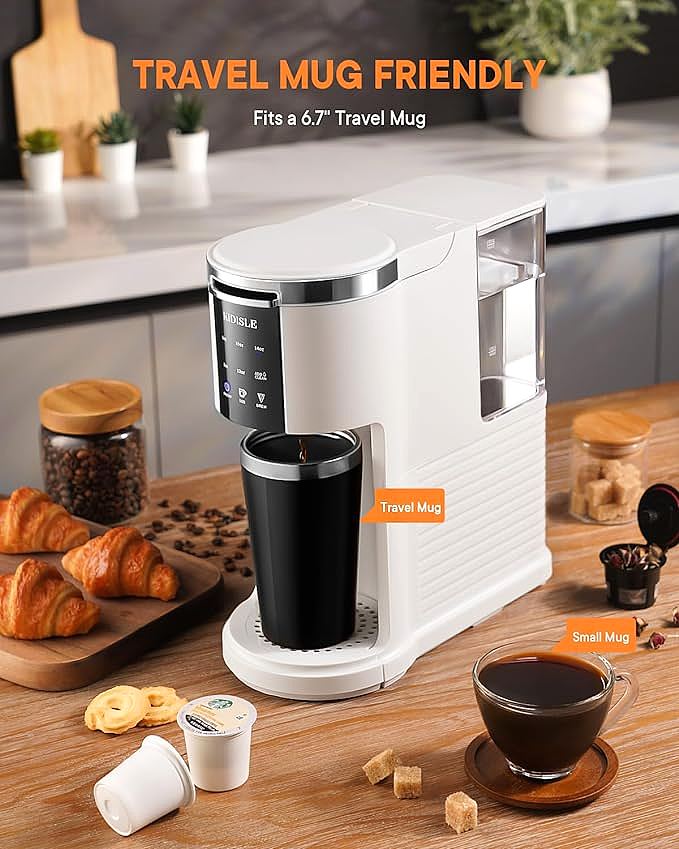
Furthermore, the machine’s "travel mug friendliness" is a function of vertical clearance. By allowing for a removable drip tray, the unit opens up a 7.2-inch vertical space, accommodating the tall, insulated vessels common in modern commuter culture.
Hygiene in Enclosed Systems
One of the criticisms often leveled at compact, enclosed systems is the potential for moisture retention. In any thermal system where water is heated and cooled, condensation is inevitable. If a machine is too tightly sealed, this moisture creates an incubator for biofilm and mold.
The KIDISLE mitigates this through modularity. The water reservoir is fully removable, breaking the "closed loop" and allowing for thorough scrubbing and air-drying. The drip tray, another common vector for bacterial growth, is also detachable. While some users note that the internal chamber can retain moisture (a common trait in all thermal siphons), the ability to mechanically disassemble the wet zones is a crucial feature for long-term hygiene in a compact footprint.
Adaptation to Modern Vessels
The brewing ecosystem has expanded beyond the standard ceramic mug. The modern user consumes beverages in a variety of vessels, from demitasse espresso cups to 20oz vacuum-insulated tumblers.
The structural design of the KIDISLE acknowledges this variance. The 3-in-1 capability—handling K-Cups, loose grounds, and tea—combined with the adjustable brew sizes (6oz to 14oz), transforms the narrow unit into a versatile beverage hub. It eliminates the need for a separate tea kettle or a separate pod machine, further adhering to the principle of "function consolidation," which is essential for decluttering small spaces.
Future Trends in Micro-Appliance Design
The trajectory of appliance design is clear: density and efficiency. The KIDISLE CM9429D-UL represents the current standard for this philosophy, proving that a machine need not be massive to be capable. By prioritizing vertical storage and hybrid functionality, it addresses the core tension of the modern kitchen—the desire for limitless options within limited space. As we move forward, we can expect this "slim" aesthetic to dominate, turning our countertops into highly efficient, modular command centers for daily nourishment.