The Physics of the Grind: Conical Burrs & Thermal Control
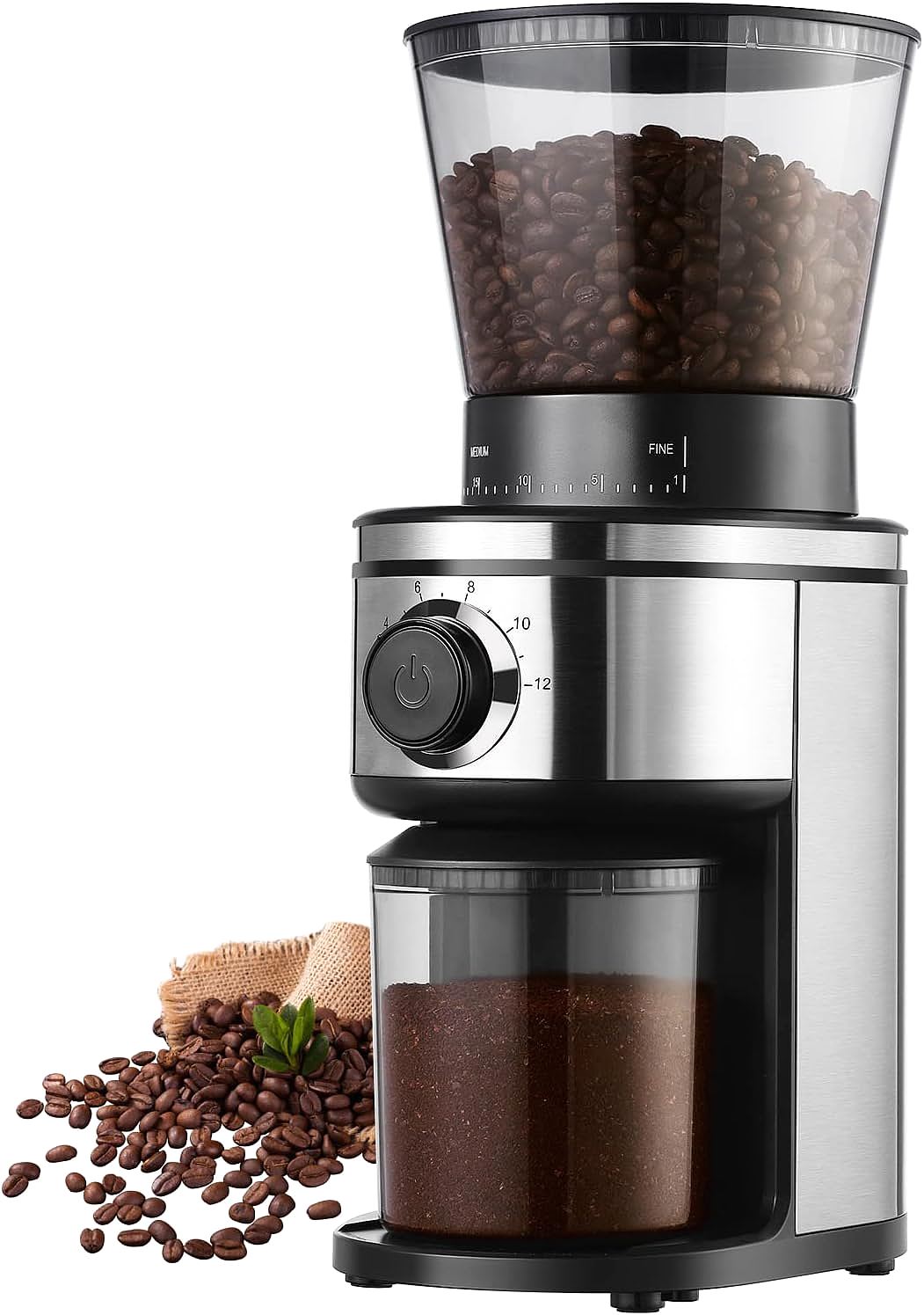
Ollygrin BG702S Burr Grinder
In the transformation from roasted bean to liquid elixir, the grinder is the primary architect. It determines the surface area available for extraction, the flow resistance of the coffee bed, and ultimately, the flavor profile in the cup. While blade grinders operate on chaos (random impacts), burr grinders like the Ollygrin BG702S operate on Geometry.
To understand why a dedicated burr grinder is non-negotiable for serious coffee brewing, we must delve into the physics of Comminution (size reduction), the thermodynamics of friction, and the mechanical engineering of torque. The Ollygrin BG702S serves as a case study in how these principles are applied to preserve the volatile integrity of the coffee bean.
The Geometry of Crushing: 40mm Conical Burrs
The heart of the BG702S is a 40mm Stainless Steel Conical Burr set. Unlike flat burrs which use centrifugal force to push beans through parallel teeth, conical burrs use gravity and auger-like geometry.
* The Primary Crush: The upper section of the cone has large, aggressive teeth. These "breakers" grab the whole bean and crack it into coarse chunks (pre-grinding).
* The Milling Zone: As the chunks fall lower, the teeth become finer and the gap between the inner cone and outer ring narrows. Here, the particles are milled to the final size.
* Particle Shape: Conical burrs tend to produce a Bimodal Particle Size Distribution. This means there are two peaks in the size graph: one for the target grind size, and a secondary peak of "fines" (microscopic dust).
* The Physics of Taste: While often debated, this bimodal distribution is favored for traditional espresso and medium roasts. The main particles provide the structure and flow rate, while the fines provide the "body" and texture by dissolving more readily. This contrasts with the unimodal (highly uniform) distribution sought for ultra-clear pour-overs, illustrating that "uniformity" is nuanced in coffee physics.
The use of Stainless Steel (likely hardened) ensures that the cutting edges remain sharp. Dull burrs don't cut; they mash. Mashing creates excessive friction and heat, destroying flavor before water is even added.

Thermodynamics of RPM: The Gear Reduction Motor
A common flaw in consumer grinders is high speed. Direct-drive motors often spin at 10,000+ RPM to compensate for low torque.
The Ollygrin BG702S employs a Gear Reduction Motor. This is a transmission system.
* Torque vs. Speed: By stepping down the speed (likely to <500 RPM), the system multiplies torque. It allows the burrs to chew through dense, light-roast beans without stalling, using sheer mechanical advantage rather than momentum.
* Thermal Management: Friction generates heat ($Q = \mu N v$). By reducing velocity ($v$), the heat generation is drastically lowered.
* Volatile Preservation: Coffee aroma consists of highly volatile organic compounds (VOCs). If the grinder heats the grounds during processing, these VOCs flash off into the kitchen air instead of the cup. Low-speed grinding keeps the beans cool, locking the aromatics inside the cellular structure until water extraction occurs.
This engineering choice shifts the grinder from a "blender" to a "mill." It prioritizes the integrity of the ingredient over the speed of the process.

Mechanical Safety: The Friction Clutch
Grinding is a violent process. Occasionally, a foreign object (a small stone or unroasted "quaker") enters the hopper. In a direct-drive system, this jams the burrs and burns out the motor.
The BG702S features a Friction Clutch.
* The Mechanism: If the resistance torque exceeds a safety threshold, the clutch slips. The motor continues to spin (protecting its windings from over-current), but the burrs stop.
* The Engineering: This is a mechanical fuse. It sacrifices continuity for survivability. It protects the precision alignment of the burrs and the lifespan of the motor, acknowledging that real-world agricultural products (coffee beans) are never 100% pure.
Case Study: Engineering for the Countertop
The compact dimensions ($5.4" \times 7"$) of the BG702S belie its internal complexity. * Vertical Integration: The conical burr design allows for a vertical alignment of motor, gears, and burrs. This "stacked" architecture minimizes the footprint. * Hopper Dynamics: The 10oz hopper uses gravity to feed beans. The "Auto-locking System" mentioned is a safety interlock—preventing the machine from running if the hopper isn't seated, protecting fingers from the moving auger.
Conclusion: The Precision of Slowness
The Ollygrin BG702S demonstrates that in coffee grinding, Slowness is a Virtue. By using gear reduction to lower RPM, it preserves the thermal and chemical integrity of the coffee. By using conical burrs, it creates a particle structure optimized for rich, full-bodied extraction.
It transforms the act of grinding from a noisy, violent chore into a controlled, precise mechanical process. For the coffee enthusiast, it is the first and most critical step in the chain of flavor, ensuring that the potential locked within the roasted bean is fully realized in the cup.