The Architecture of Versatility: Engineering 3-in-1 Systems
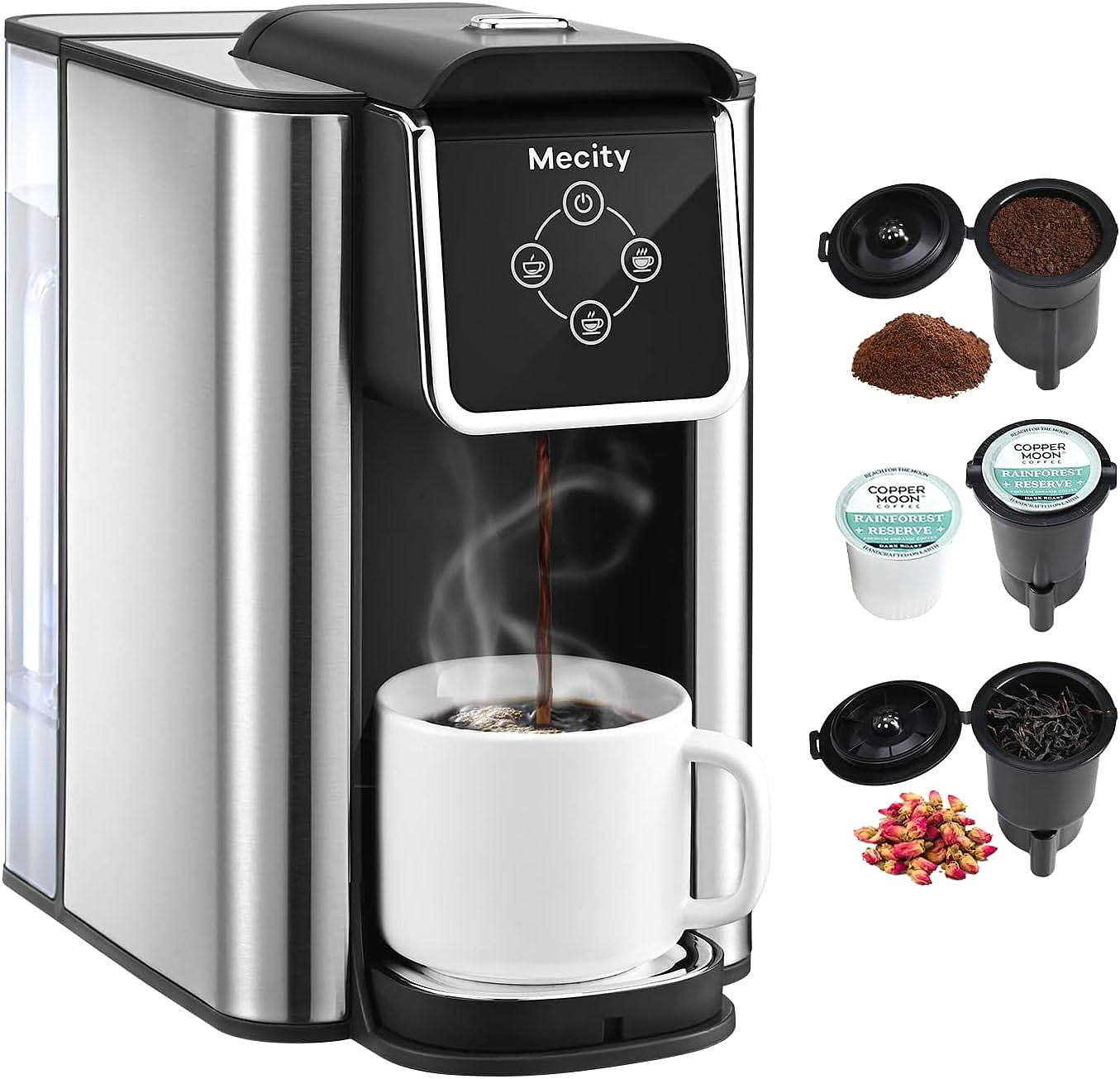
Mecity KC101 3-in-1 Single Serve Coffee Machine
In engineering, specialization usually yields the highest performance. A Formula 1 car is fast but cannot carry groceries. A dump truck carries loads but is slow. The Mecity KC101 attempts the engineering equivalent of a crossover vehicle: a 3-in-1 Hybrid capable of handling pressurized K-cups, loose grounds, and tea leaves.
Achieving this versatility requires a sophisticated Interface Design. The machine must adapt its physical geometry to accommodate different media while maintaining the correct fluid dynamics for each. Furthermore, the longevity of such a complex system depends heavily on Chemical Maintenance. This article explores the mechanical logic of multi-filter systems and the chemistry of descaling.
The Mechanical Interface: Adapting to the Media
The core innovation of the KC101 is its interchangeable filter pod system. * The K-Cup Pod: This module contains a hollow needle. Its function is to pierce the foil lid of the commercial capsule. Mechanically, it must create a high-pressure seal around the rim of the cup to prevent bypass leakage. The water is injected centrally and must diffuse radially through the packed coffee. * The Grounds Filter: This basket is larger. It lacks the needle but has a mesh bottom. The physics here changes from "injection" to "shower." The water must be distributed over the bed of grounds to prevent channeling. The increased volume allows for a larger dose (stronger coffee), but the lack of pressure sealing means the extraction relies more on gravity and less on pump force. * The Tea Filter: Tea leaves expand significantly (up to 5x dry volume). The tea filter module must offer enough volume for this expansion ("agony of the leaves") to ensure proper diffusion of flavor compounds. If the basket is too small, the leaves compress, blocking flow.
The challenge for Mecity engineers was to design a single Group Head (the part where water exits the machine) that can mate with all three distinct geometries. This likely involves a spring-loaded seal mechanism that adjusts to the height and rim diameter of the inserted pod.

Material Science: The BPA-Free Imperative
The product description highlights "BPA-FREE material for water tank and piercing needle." This is a critical specification in the context of hot water extraction. * Hydrolysis Resistance: Coffee machines operate at $90^{\circ}C+$. Many plastics degrade under thermal cycling (heating and cooling). Bisphenol A (BPA) was a common hardener in older polycarbonates, but it can leach endocrine-disrupting chemicals under heat. * The Alternatives: Modern machines use materials like Polypropylene (PP) or Tritan. These polymers are thermally stable and chemically inert. * The Stainless Steel Accent: While the exterior finish is aesthetic, internal stainless steel components (like the heater tube) are vital for corrosion resistance against acidic coffee oils and mineral-rich water.
The Chemistry of Maintenance: Descaling Protocol
The most common failure mode for single-serve brewers is Scale Accumulation.
Tap water contains dissolved Calcium ($Ca^{2+}$) and Bicarbonate ($HCO_3^-$). When heated, these react to form Calcium Carbonate ($CaCO_3$), a rock-hard precipitate known as limescale.
$$Ca^{2+} + 2HCO_3^- \rightarrow CaCO_3(s) + CO_2 + H_2O$$
Scale coats the heating element, acting as a thermal insulator. This forces the element to run hotter to heat the water, eventually leading to burnout. It also clogs the narrow needle and pump valves.
The KC101’s "Descale Mode" is a programmed cycle designed to circulate an acidic solution (vinegar or citric acid).
* The Reaction: Acid ($H^+$) reacts with the carbonate scale, dissolving it back into soluble ions and releasing carbon dioxide gas.
$$CaCO_3 + 2H^+ \rightarrow Ca^{2+} + H_2O + CO_2$$
* The Logic: The flashing light reminder is not a suggestion; it is a sensor-based or timer-based alert indicating that the hydraulic resistance of the system has increased (or time has passed), putting the pump at risk. Ignoring this leads to the "snorting noises" and reduced flow mentioned in user reviews.

User Experience Engineering: Height and Drip Trays
Fluid dynamics also applies to the cup. The Removable Drip Tray accommodates cups up to 6.3 inches tall. * Splash Dynamics: The distance between the nozzle and the cup surface determines splashing. A shorter distance maintains a laminar stream; a longer distance allows the stream to break up into droplets (Rayleigh-Plateau instability), causing splashes. By removing the tray for tall travel mugs, the user maintains the optimal nozzle-to-surface distance. * Cleaning Access: Coffee residue is oily and acidic. A removable tray allows for sink